
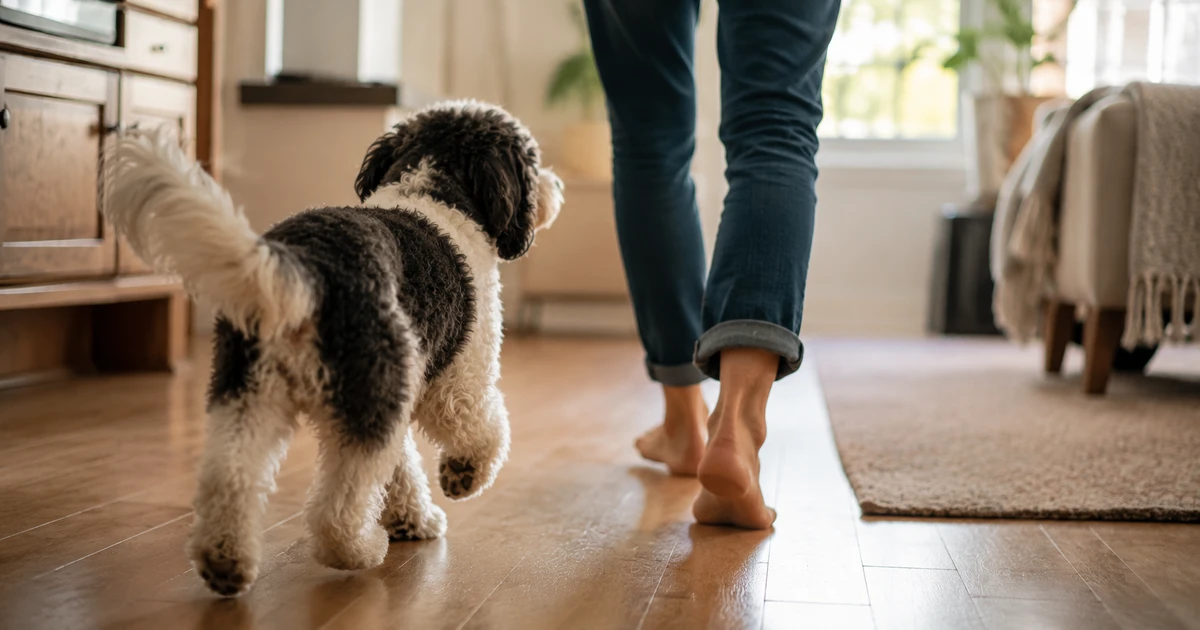
Some dogs will happily nap across the room from you. Others treat every trip to the bathroom like a two-person expedition. If you’ve got a dog that shadows your every move, you’re dealing with completely normal (if occasionally underfoot) canine behavior — with a few exceptions worth knowing about.
It’s rooted in pack instinct and attachment
Dogs descended from social, cooperative hunters, and that history shows up in how strongly they bond to their household — you specifically function as their social anchor. Following you room to room is a low-effort way of staying close to the group and keeping tabs on what’s happening, the same instinct that would have kept a wild canine near its pack. On top of that, dogs form genuine attachment bonds with their owners, not unlike the parent-child attachment studied in human psychology — you’re their secure base.
You’re also the source of everything good
From a dog’s perspective, you’re the one who controls food, walks, play, and attention. Simple learned association means that staying near you maximizes the odds that something good is about to happen. This is reinforced every time following you leads to a reward — a treat, a walk, a scratch behind the ears — even if you didn’t intend it as training.
Some breeds are bigger “velcro dogs” than others
- Herding breeds (Border Collies, Australian Shepherds, Corgis): bred to work closely with a handler, so shadowing comes naturally
- Companion/toy breeds (Maltipoos, Cavalier King Charles Spaniels, Chihuahuas): bred specifically for close human companionship
- Retrievers (Labradors, Golden Retrievers): highly people-oriented, bred to work in close partnership with a handler
- Independent breeds (Basenjis, Shiba Inus, Afghan Hounds): historically bred for more independent work, tend to be less velcro-like
Age and life stage matter too — puppies and newly adopted dogs often follow more closely simply because everything is new and you’re their most familiar point of reference. This usually settles somewhat as a dog matures and becomes more confident in a new home.
When following becomes separation anxiety
Normal attachment-following and separation anxiety look similar on the surface but are functionally different. A dog that simply prefers to be near you will settle calmly nearby, sleep, or occupy itself once you stop moving. A dog with separation anxiety typically shows genuine distress — not just a preference — when separated, even briefly.
If your dog shows real distress rather than just wanting to be nearby, it’s worth talking to your vet or a certified trainer — separation anxiety is very manageable with the right desensitization approach, but it typically doesn’t resolve on its own and can worsen if left unaddressed.
Frequently asked questions
Is it bad to let my dog follow me everywhere?
No — for most dogs, this is a normal expression of attachment and doesn’t need to be discouraged. If it becomes disruptive (tripping hazards, anxiety when you’re in a room they can’t access), teaching a solid “place” or “settle” command can give your dog an alternative way to stay close without being underfoot.
Why has my dog suddenly started following me more than usual?
A sudden increase in clinginess can be behavioral (a recent change like a move, a new pet, or a household stressor) or medical (dogs in pain or feeling unwell often seek more closeness). If there’s no clear behavioral trigger and the change is sudden, a vet check is a reasonable first step to rule out a physical cause.
Do older dogs follow their owners more?
Often, yes — senior dogs can become more attached as their vision or hearing declines, since staying close to you provides more of the sensory reassurance they’re losing elsewhere. It can occasionally be a sign of early cognitive changes as well, so a vet visit is worthwhile if it’s a sudden shift.