
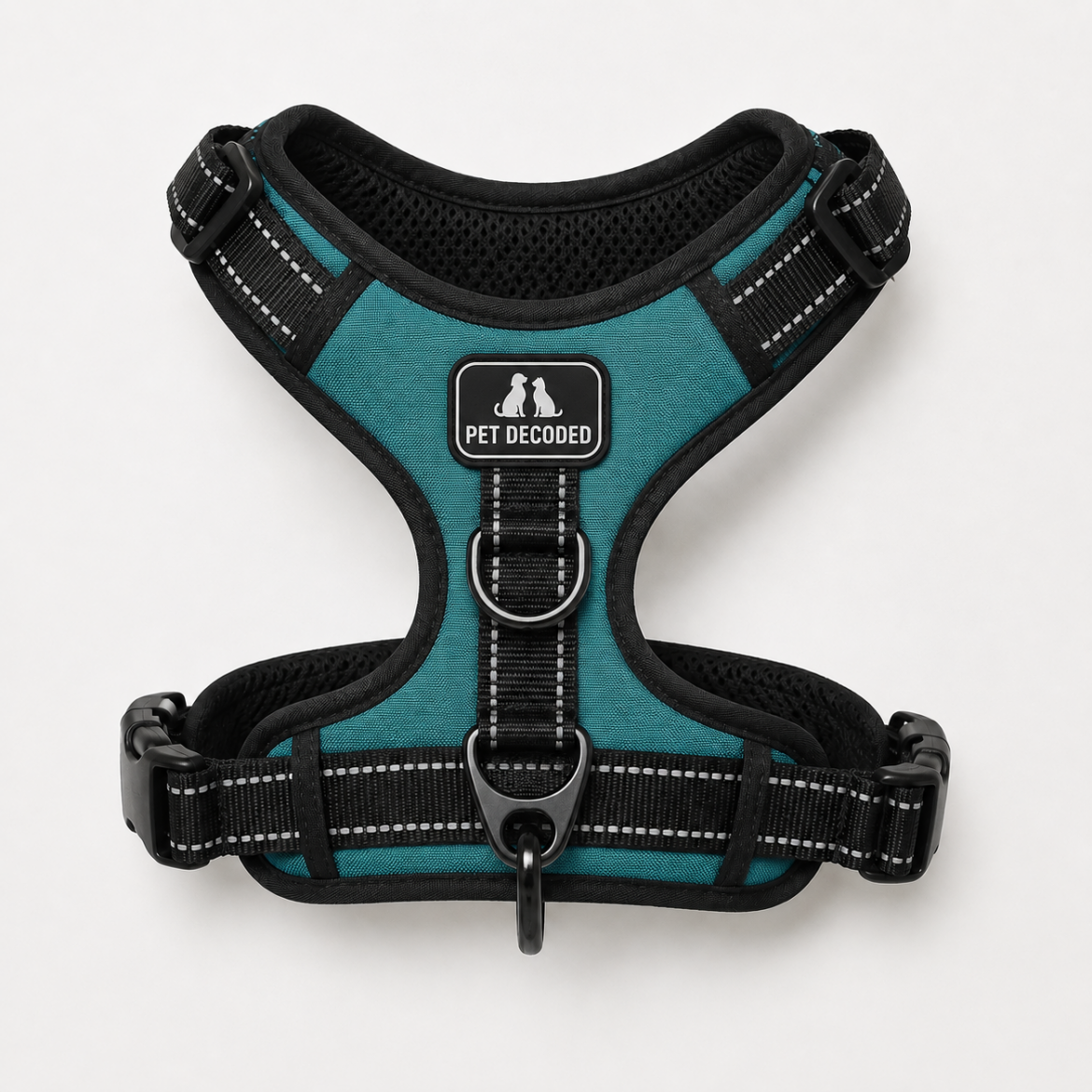
A leash and harness feel like a solved problem until you’re standing in an aisle facing forty options, half of which are wrong for your specific dog. What actually matters comes down to what you’re solving for — a puppy still learning manners, a strong dog that pulls, or a runner who wants hands-free. Here’s how to pick by need instead of by star rating.
Best for a dog that pulls: front-clip no-pull harness
The single most effective piece of gear for leash training a dog that pulls.
PetSafe Easy Walk No-Pull Harness

The most widely recommended front-clip harness on the market, and for good reason: the chest strap sits right at the sternum, so when your dog pulls forward, the martingale-style loop redirects them sideways and off-balance instead of letting them drive ahead. It’s the fastest-acting option for a dog with a genuinely strong pulling habit. This doesn’t replace training — see our guide to stopping leash pulling for the actual method — but it makes walks manageable while the training takes hold.
Shop on AmazonRuffwear Front Range Harness

A step up in padding and build quality from the PetSafe pick, designed to hold up to years of trail use rather than just daily neighborhood walks. The wider, padded chest and belly panels distribute pressure more comfortably on longer hikes, and a sturdy top handle gives you a quick grip for scrambling over uneven terrain or helping your dog into a car. Pricier than a standard harness, but built for owners who are genuinely out on trails regularly, not just around the block.
Shop on AmazonBest everyday leash
A standard leash that holds up to daily wear.
Mighty Paw Padded Dog Leash

A 6-foot length is the standard recommendation for everyday walking — long enough to give your dog some room to sniff, short enough to maintain real control near traffic or other dogs. This one has a padded handle (worth prioritizing if your dog pulls at all) and a metal, not plastic, clasp, which holds up far longer under repeated stress.
Shop on AmazonBest for runners: hands-free leash
For owners who run or hike regularly with their dog.
Tuff Mutt Hands-Free Dog Leash

A waist-belt leash with a bungee, shock-absorbing section that reduces the jolt when your dog surges ahead mid-run, which matters both for your shoulder and your dog’s neck or chest. Reflective stitching is worth prioritizing if you run early morning or evening, and this one includes it standard.
Shop on AmazonBest collar for escape-prone or narrow-headed dogs
Tightens gently to prevent slipping out, without choking.
PetSafe Martingale Dog Collar

Breeds with a narrower head than neck — Greyhounds, Whippets, and similar sighthounds especially — can back out of a standard buckle collar with surprising ease. A martingale collar tightens slightly when a dog pulls backward, just enough to prevent slipping out, without the full choking action of an old-style choke chain. Genuinely useful as a safety layer for any dog with a history of backing out of a collar, not just sighthounds.
Shop on AmazonBest slip lead for quick control
A vet-office and trainer favorite for fast on-off control.
Mendota Slip Lead

Combines a collar and leash into one piece that slips on and off in seconds — the reason it’s the standard at most vet clinics and shelters. Useful as a backup in the car or bag for situations where fumbling with a harness isn’t practical, though it’s not a substitute for a proper harness on regular walks with a dog that pulls, since it does apply pressure around the neck.
Shop on AmazonBest ID and GPS options
Worth the investment if your dog’s ever gotten loose.
Fi Series 3 GPS Dog Collar

A dedicated GPS collar with real-time LTE tracking and exceptional battery life (up to 3 months in normal mode), which matters since a tracker that needs charging every few days is a tracker that’s dead exactly when you need it. Note: the Whistle brand of GPS trackers was discontinued in 2025 after being acquired by Tractive, so avoid that name if you see it referenced in older gear guides — Fi and Tractive are the current leading options.
Shop on AmazonTractive GPS Dog Tracker

Rather than a full replacement collar, Tractive clips onto a collar your dog already wears, which is the better fit if you don’t want to swap out their everyday collar for a bulkier GPS unit. It currently offers the fastest live-tracking update speed of the leading options, useful in the first few minutes after a dog goes missing when every update matters. Battery life runs shorter than Fi’s between charges, a real tradeoff for the more compact, clip-on form factor.
Shop on AmazonHarness vs. collar: which should you actually use?
For daily walking, a harness is generally the safer default — it distributes pressure across the chest and shoulders rather than concentrating it on the neck, which matters for both comfort and for dogs prone to tracheal sensitivity (common in small breeds) or neck injury risk from repeated leash pressure. A collar with ID tags is still worth keeping on at all times for identification, even if the leash itself clips to a harness.
Frequently asked questions
Is a harness better than a collar for walking?
For most dogs, yes — a harness distributes pressure more safely than a collar, especially for dogs that pull or have any neck sensitivity. A collar is still worth keeping on for ID purposes even when the leash attaches to a harness.
What length leash is best for city walking?
A standard 6-foot leash offers the best balance of control and freedom in busy urban environments with traffic, crowds, and other dogs. Retractable leashes are generally discouraged in these settings due to reduced control.
What’s a martingale collar and who actually needs one?
It’s a collar that tightens slightly when a dog pulls back, just enough to prevent slipping out without choking — most useful for narrow-headed breeds like Greyhounds and Whippets, or any dog with a track record of backing out of a standard collar.
Are retractable leashes ever a good idea?
They can work in wide-open, low-traffic areas with a well-behaved dog, but most trainers discourage them for everyday walking — the thin cord offers poor control in an emergency and can cause real injury (rope burn, cuts) to both dog and owner if it’s grabbed suddenly.
How do I know if a harness fits correctly?
You should be able to fit two fingers snugly under any strap, with no gap loose enough for a paw or head to slip through and no strap so tight it rubs or restricts movement. Check the fit again after the first few walks, since harnesses can shift slightly as your dog settles into it.