
Whether you need a daily dog walker while you’re at work, occasional drop-in visits, or a trustworthy sitter for a weekend away, the two biggest national platforms — Rover and Wag — take genuinely different approaches. Here’s how they actually compare, plus when a local independent walker might be the better call.
Quick comparison
| Rover | Wag | |
|---|---|---|
| Booking model | Browse profiles, choose your own walker/sitter | On-demand dispatch to nearest available walker |
| Best for | Recurring care, ongoing relationships | Last-minute, same-day bookings |
| 30-min walk, typical cost | ~$30–$35 to owner | $24 + $2.99 booking fee (waived with Premium) |
| Platform fee (walker’s cut) | ~20–25% (walker keeps ~75–80%) | ~30–40% (walker keeps ~60–70%) |
| Services offered | Walks, drop-ins, boarding, house sitting, daycare | Walks, drop-ins; boarding/sitting more limited |
| Insurance | Included on all bookings | $1M secondary coverage |
| Subscription option | No | Wag Premium, $14.99/mo (discounts, priority booking) |
The two platforms, in detail

Rover
Rover is a marketplace, not a dispatch service — you browse walker and sitter profiles, read reviews, and book someone specific, which makes it the better fit for building an ongoing relationship with one trusted caregiver rather than getting a different person every time. Because Rover’s platform fee is meaningfully lower than Wag’s, more of what you pay actually goes to the walker, which in practice tends to attract more experienced, higher-retention caregivers to the platform. Rover also offers the widest range of services on one platform: walks, drop-in visits, boarding, in-home pet sitting, and daycare, all bookable through the same profiles and reviews system.
Pros
- Choose and vet your own walker/sitter
- Widest range of services (walks through boarding)
- Lower platform fee attracts better-retained walkers
- Strong review and profile system
Cons
- Not built for urgent, same-day bookings
- Provider fee and separate owner booking fee can make total pricing less transparent upfront
Wag
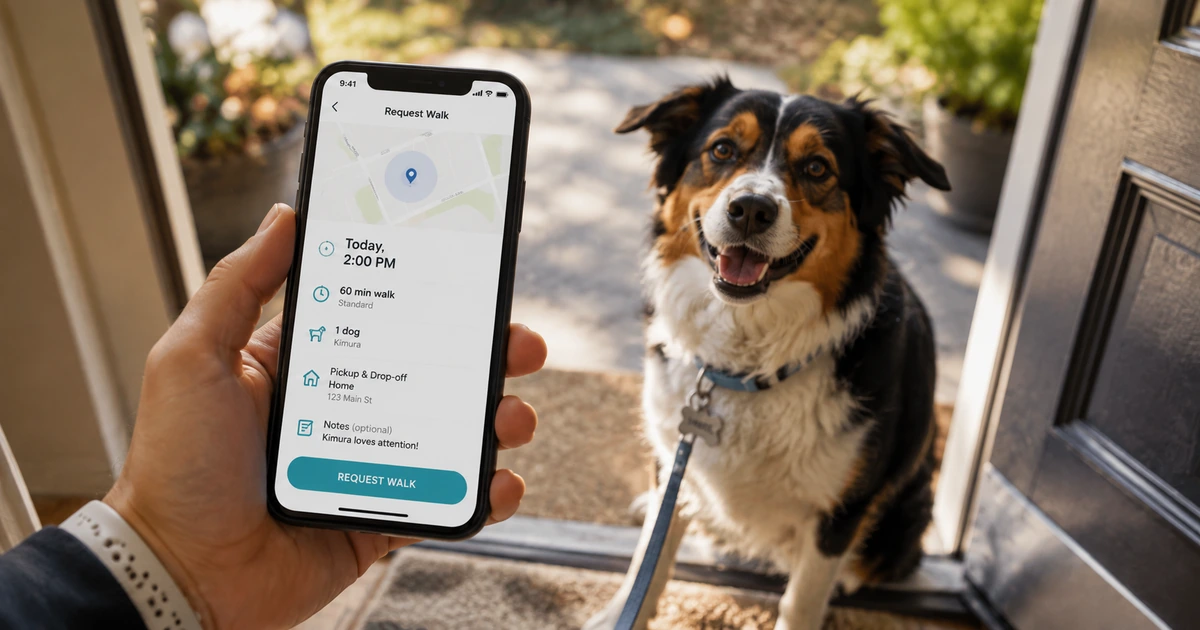
Wag is built around speed: request a walk and the app dispatches the nearest available walker, often within about 15 minutes, which is genuinely useful when plans change suddenly and you can’t wait to browse and message a specific person. The tradeoff is a meaningfully higher platform fee (roughly 30–40%, versus Rover’s 20–25%), which means less consistency in who shows up and can mean lower walker retention on the platform. Wag Premium ($14.99/month) adds booking discounts and priority scheduling, but only pencils out if you’re booking frequently — roughly four or more walks a month.
Pros
- Fast, on-demand dispatch (often under 15 min)
- GPS tracking on every walk
- Good for occasional or emergency needs
Cons
- Higher platform fee than Rover
- Less consistency — often a different walker each time
- More limited boarding/sitting options
What about a local, independent dog walker?
A well-reviewed independent local walker or small pet-care business can be a genuinely strong option, particularly for daily recurring care — you often get more consistency (the same person every time) and sometimes a lower cost than either platform, since there’s no marketplace fee. The tradeoff is more upfront legwork: you’re responsible for vetting, checking references, and arranging insurance or liability coverage yourself, rather than relying on a platform’s built-in background checks and insurance. For occasional or first-time needs, a platform’s built-in vetting is worth the fee; for a daily long-term arrangement, a trusted local option is worth exploring once you’ve found someone reliable.
How to vet a walker or sitter, on any platform
- Do a meet-and-greet first: both platforms support (and most experienced owners recommend) a free initial meeting before the first paid booking, so your dog and the walker can get comfortable before you’re not there to supervise
- Read recent reviews, not just the overall rating: a 4.9 average can still hide a couple of recent reviews mentioning missed visits or communication issues worth knowing about
- Confirm how updates are sent: most reliable walkers send a photo or GPS map after every visit — if a profile’s reviews mention inconsistent updates, that’s worth asking about directly before booking
- Leave clear written care instructions: feeding schedule, any medications, behavioral quirks (reactive to other dogs, escape-prone, etc.), and emergency vet contact info, so nothing depends on a walker guessing correctly
How to choose
Frequently asked questions
Is Rover or Wag cheaper?
Rover’s lower platform fee generally means more of your payment goes to the walker rather than the platform, but the total price to you as an owner is often fairly comparable between the two for a standard walk — the bigger practical difference is booking speed and consistency, not raw price.
Are dog walkers on these apps insured?
Yes — both Rover and Wag include liability insurance coverage on bookings made through their platforms, which is one of the key advantages over hiring an independent walker without your own separate coverage arrangement.
Can I use both Rover and Wag?
Yes, plenty of owners use Rover for planned, recurring care and keep Wag as a backup for last-minute situations when their regular walker isn’t available.
Do I need to be home when a dog walker comes?
No — most bookings are designed for you to be away, with the walker using a lockbox code, smart lock, or key you’ve arranged in advance. Both platforms have secure processes for this built into their booking flow.
Do Rover and Wag run background checks on walkers?
Yes — both platforms require walkers and sitters to pass a background check before they can accept bookings, which is one of the main advantages over finding someone through an unvetted classifieds listing.
What happens if my walker cancels last minute?
Both platforms let you rebook quickly through the app, and Wag’s on-demand dispatch model in particular is built to fill a gap fast. On Rover, having a couple of backup walkers already saved to your favorites makes a last-minute cancellation much less stressful to handle.