
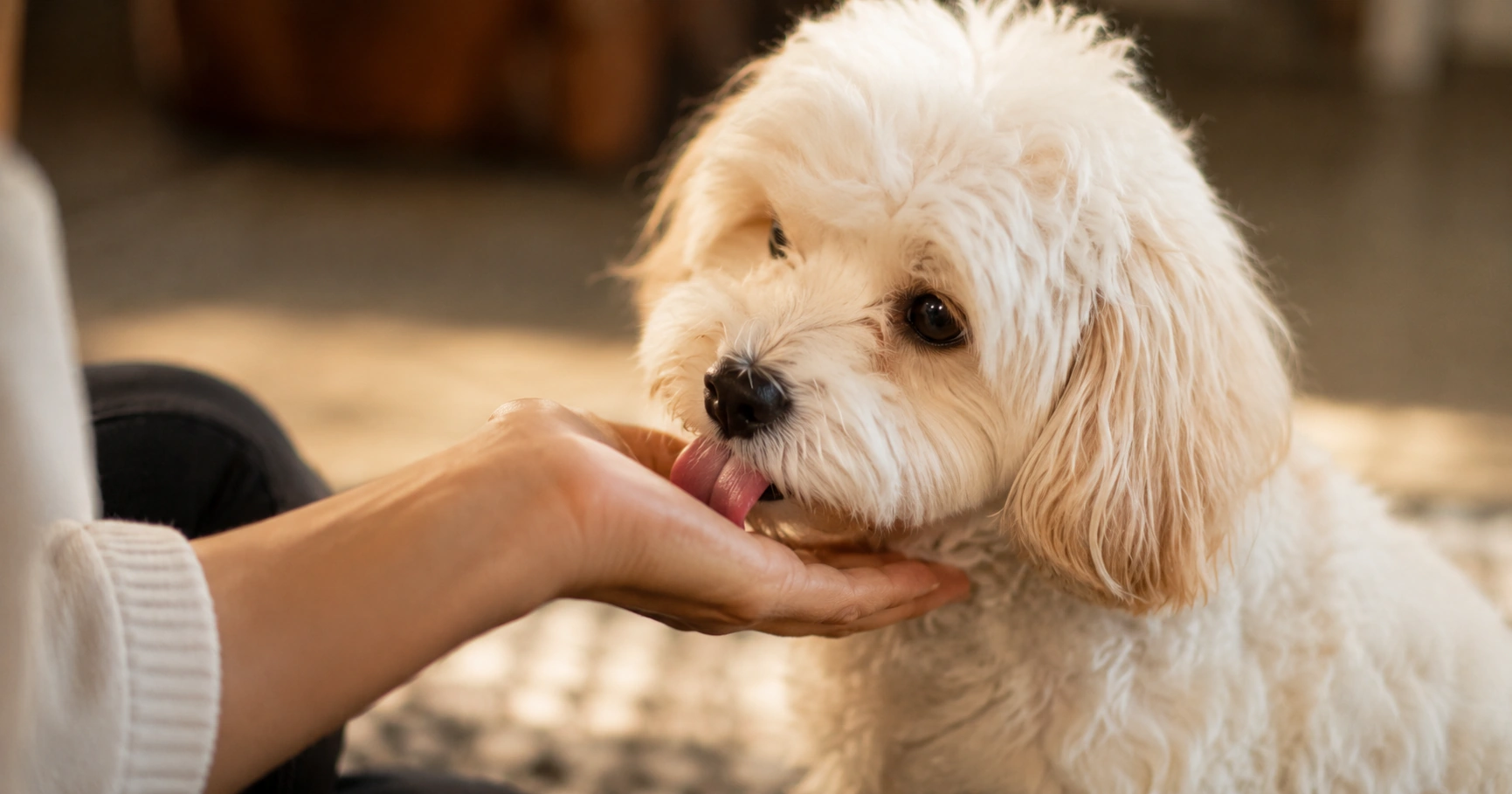
Dog kisses are one of those things owners either love or find a little much — but either way, the behavior itself is worth understanding, because “my dog licks me” covers a range of very different underlying reasons.
It starts as instinct from puppyhood
Puppies lick their mother’s face to stimulate her to regurgitate food (an instinct inherited from wild canines) and are groomed by licking from birth. That early wiring doesn’t disappear in adulthood — licking stays associated with closeness, care, and social bonding throughout a dog’s life, which is a big part of why it gets redirected toward you.
It’s a bonding and calming behavior
Licking triggers the release of endorphins in dogs, which has a mild calming, pleasurable effect — not unlike how humans might find a repetitive, soothing action relaxing. Licking you specifically can be your dog’s way of expressing affection, seeking closeness, and self-soothing all at once, especially if it happens during calm moments like cuddling on the couch.
You probably just taste interesting
Dogs have an extraordinarily sensitive sense of smell and taste compared to humans, and your skin carries salt, oils, and traces of whatever you’ve been doing that day. Hands especially — if you’ve been cooking, eating, or handling anything food-related — are a common target simply because there’s something worth investigating there.
It’s often a learned attention-getter
If licking has ever gotten a reaction from you — a laugh, a scratch behind the ears, even just eye contact — your dog has learned that it works. Dogs are quick studies of what gets a response, and licking is a low-cost, high-reward behavior to keep in the toolkit for getting your attention when they want it.
- Licking during cuddles/calm time: almost always affection and bonding
- Licking your hands after cooking/eating: taste-driven, purely opportunistic
- Licking that starts the moment you stop paying attention: learned attention-seeking
- Licking that’s frantic, repetitive, or directed at the air/surfaces: worth a closer look (see below)
When licking points to something else
Occasionally, excessive licking is a sign of stress, anxiety, or nausea rather than affection. Dogs experiencing nausea will sometimes lick their lips, the air, or nearby surfaces repeatedly — a behavior that looks superficially similar to affectionate licking but has a different rhythm and intensity, and usually isn’t directed specifically at a person. Anxious dogs may also develop excessive self-licking (of their own paws or body) as a stress-relief or compulsive behavior, which is different from licking you.
Frequently asked questions
Should I let my dog lick my face?
It’s mostly a matter of personal preference and hygiene rather than a safety issue for most healthy people — a dog’s mouth isn’t dramatically “cleaner” or “dirtier” than a human’s, just different. If you’d rather redirect it, calmly turning your head and offering a hand instead, paired with consistent redirection over time, works better than scolding.
Why does my dog lick my feet specifically?
Feet carry a concentrated amount of scent and sweat, which makes them especially interesting to a dog’s nose. It’s usually the same taste/scent-driven curiosity as licking hands, just aimed at a body part with more to investigate.
Why does my dog lick me right before bed?
This is commonly a calming, bonding ritual — similar to how some dogs circle before lying down. It’s often paired with settling in for the night and is generally nothing to worry about if your dog seems relaxed rather than agitated while doing it.