
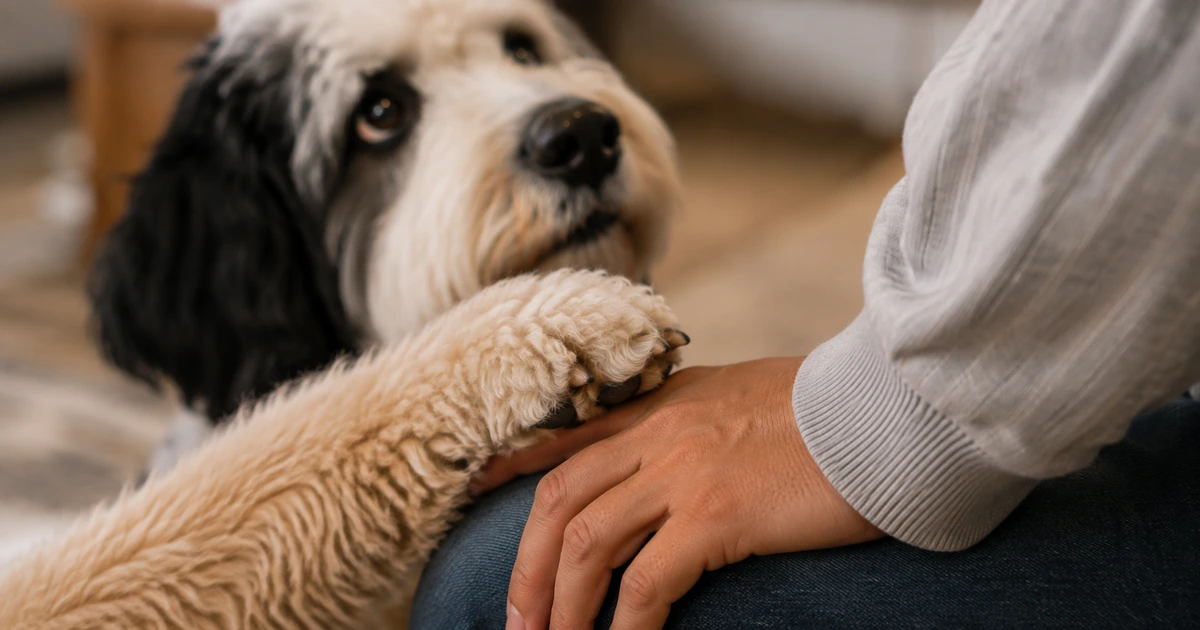
That deliberate little paw-on-the-knee move has a lot of personality behind it, and honestly, it’s one of the more clearly “on purpose” gestures a dog makes — unlike a lot of dog behavior that’s pure instinct, this one reads as genuinely intentional communication.
It likely starts as a puppy behavior
Puppies paw at their mother while nursing (a behavior called “kneading” or “treading,” thought to help stimulate milk flow) and paw at littermates during play to get attention or initiate interaction. That early pattern of “use my paw to get a response from someone” carries forward into adulthood, redirected at you instead of a mother or littermate.
Mid-pet paw taps are a pretty clear ask
If you’re petting your dog, pause, and get an immediate paw on your hand or leg, that’s about as direct a “more, please” as a dog can communicate without words. It’s learned through simple cause and effect: the paw got your attention once, it worked, and now it’s a reliable go-to move whenever your dog wants something from you specifically.
It’s also just a way to physically connect
- During cuddling or calm moments: a paw resting on you can be a simple extension of physical closeness, similar to leaning against you
- When you’re upset or stressed: some dogs seem to specifically offer a paw during moments when their owner seems down, which many owners interpret (reasonably) as a form of comfort-seeking or comfort-giving behavior
- As a greeting: a paw up when you get home, alongside other excited greeting behaviors
Some dogs learn it as a trained behavior first
If “shake” or “paw” was ever taught as a trick, some dogs generalize it into a broader attention-getting tool beyond the original cue — offering the paw unprompted because it’s historically gotten a reliably positive reaction from you. This is functionally similar to the natural version, just with a more direct training origin.
Frequently asked questions
Should I reward my dog for pawing at me?
It’s a matter of preference — there’s nothing wrong with the behavior itself, but if it becomes insistent or is happening at inconvenient times (while you’re eating, working), teaching an alternative “ask” behavior (sitting quietly, for instance) can redirect the same underlying request for attention.
Why does my dog only paw at me, not other people?
This usually reflects the strength of your specific bond and the history of reinforcement between you two — your dog has learned that pawing at you specifically gets a response, which may not be true with someone they know less well or haven’t tested the behavior with.
Is pawing a sign of dominance?
Modern behavioral science has largely moved away from the older “dominance” framework for interpreting most everyday dog behaviors, including this one. Pawing is much better explained as a learned attention-seeking or affectionate gesture than any kind of status assertion.